


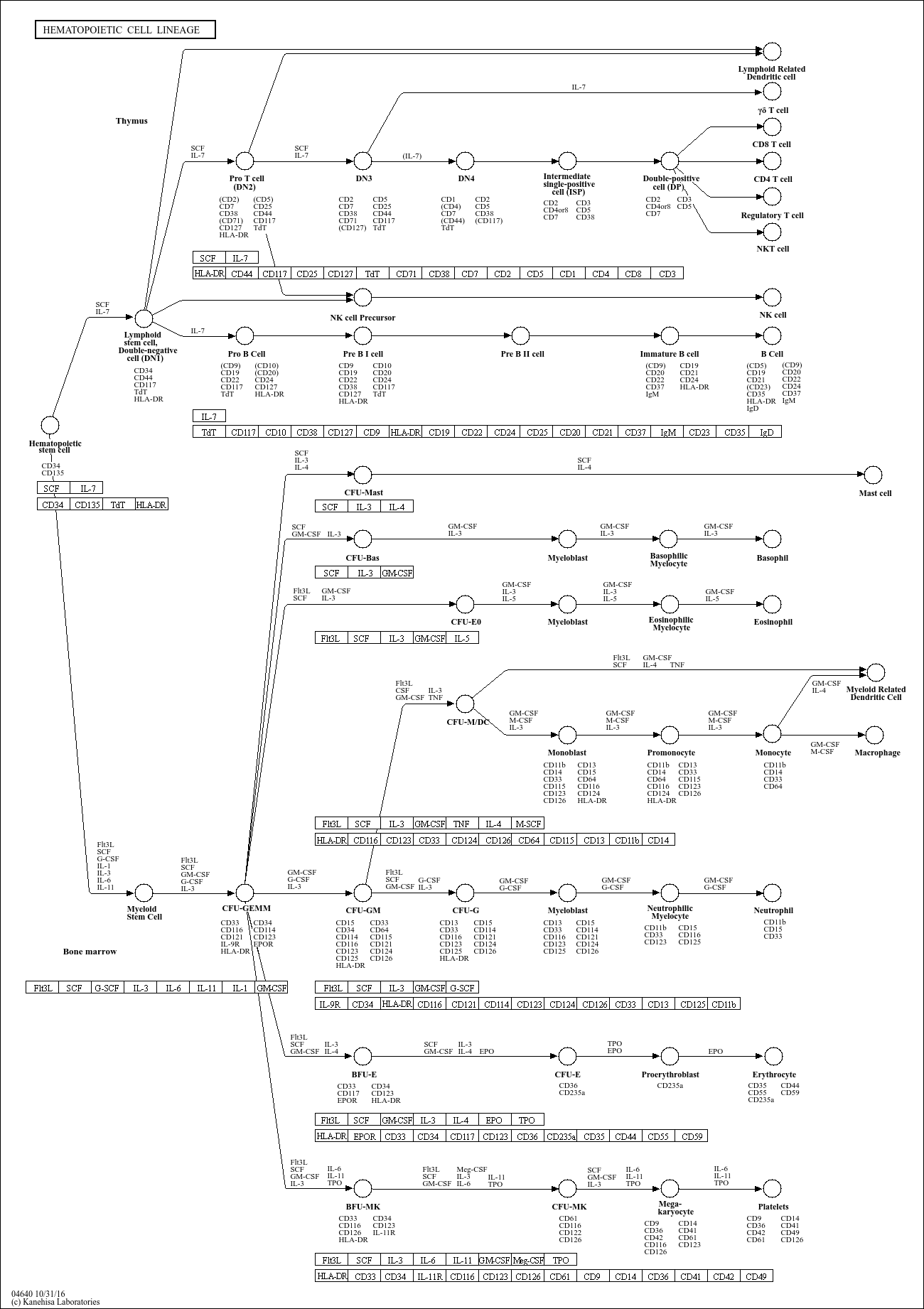
Hematopoietic cell lineage
Core of basic research: Focuses on the self-renewal and directional differentiation mechanisms of hematopoietic stem cells (HSCs) in the bone marrow niche, the core of maintaining hematopoietic homeostasis. HSCs achieve self-renewal (sustaining the stem cell pool) and directional differentiation (generating red blood cells, white blood cells, platelets, etc.) through asymmetric division, precisely regulated by cytokine signals and transcription factor networks. Cytokines (e.g., SCF, TPO, EPO) maintain HSC stemness via activating pathways like PI3K-Akt and Notch. Transcription factors exert lineage-specific regulation: GATA1 dominates erythroid differentiation, PU.1 regulates myeloid (granulocyte, monocyte) differentiation, and Runx1 participates in T/B lymphocyte differentiation. Research focuses on the regulatory role of the bone marrow niche (osteoblasts, endothelial cells) on HSCs, the synergistic/antagonistic network of transcription factors, the stabilizing effect of epigenetic modifications (DNA methylation, histone acetylation) on differentiation fate, and molecular mechanisms of HSC proliferation/differentiation disorders in hematopoietic abnormalities (e.g., leukemia, aplastic anemia).
Core key proteins: Hematopoietic stem cells (HSCs), SCF (stem cell factor), TPO (thrombopoietin), EPO (erythropoietin), GATA1 (erythroid differentiation transcription factor), PU.1 (myeloid differentiation transcription factor), Runx1 (key hematopoietic differentiation transcription factor), SCL (stem cell leukemia factor), c-Kit (SCF receptor), CD34 (HSC surface marker), STAT5 (cytokine signal transcription factor), Notch1 (HSC stemness maintenance signal).
Core key proteins: Hematopoietic stem cells (HSCs), SCF (stem cell factor), TPO (thrombopoietin), EPO (erythropoietin), GATA1 (erythroid differentiation transcription factor), PU.1 (myeloid differentiation transcription factor), Runx1 (key hematopoietic differentiation transcription factor), SCL (stem cell leukemia factor), c-Kit (SCF receptor), CD34 (HSC surface marker), STAT5 (cytokine signal transcription factor), Notch1 (HSC stemness maintenance signal).
Product list
-
{{item.title}}{{item.react}}{{item.applicat}}
Product list
Product name
Reactivity
Application
Related Resource Links



Related Promotional Journal Downloads


Explore Our Recommended Popular Products
More products

30,000+ high- quality products available online
Primary Antibodies, Secondary Antibodies, mIHC Kits, ELISA Kits, Proteins, Molecular Biology Products,Cell Lines,Reagents ...
Contact Us
-

400-801-6722
-

support@lamarck.cn
-


Order
-

Message