


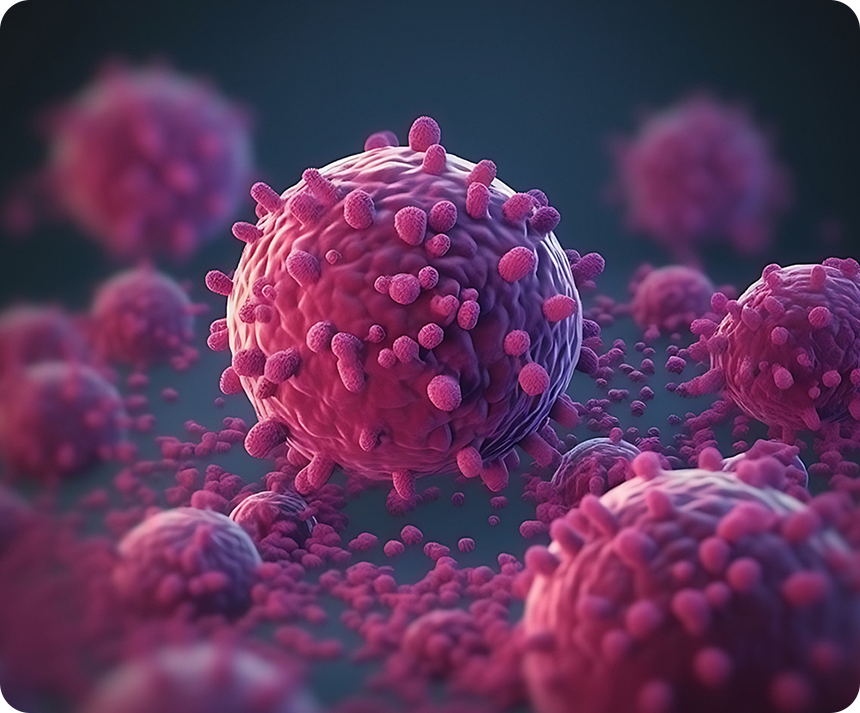
Basic research on cell division and proliferation focuses on "cell cycle regulation, precise execution of division processes, and maintenance of proliferative homeostasis". Its core is to decipher the molecular mechanisms of cells from G1 phase initiation, DNA replication (S phase), division preparation (G2 phase) to cytokinesis (M phase), clarify the association between abnormal proliferation and diseases (e.g., tumors, developmental malformations), and provide fundamental theoretical support for cell cycle-targeted therapies.
Molecular Regulatory Networks of the Cell Cycle
Checkpoint regulation: Explore the activation and inactivation mechanisms of G1/S, G2/M, and spindle assembly checkpoints; decipher cell cycle arrest signals (e.g., p53-p21 pathway, ATR/ATM kinase-mediated DNA damage response) in cases of DNA damage or abnormal chromosome alignment; and clarify the mechanisms of genomic instability caused by checkpoint defects.
Cyclin-CDK regulation: Study the sequential activation of Cyclin (e.g., Cyclin D/E/A/B) and CDK (e.g., CDK2/4/6/1) complexes; analyze the regulatory functions of CDK inhibitors (p21, p27, p16); and reveal the molecular logic by which Cyclin-CDK complexes phosphorylate downstream substrates (e.g., Rb, E2F) to drive cell cycle progression.
Ubiquitination and degradation regulation: Elucidate the cyclin degradation mechanisms mediated by ubiquitin ligases such as APC/C (Anaphase-Promoting Complex/Cyclosome) and SCF (Skp1-Cullin-F-box); and analyze the precise regulatory role of sequential degradation of key cell cycle proteins in cycle progression.
Precise Execution Mechanisms of Cell Division Processes
Mitotic regulation: Explore the molecular mechanisms of chromosome condensation, nuclear envelope breakdown, spindle assembly, chromosome segregation, and cytokinesis; decipher the regulatory logic of centrosome duplication and separation, as well as kinetochore-microtubule attachment; and clarify the causes of aneuploidy induced by chromosome nondisjunction.
Meiosis-specific mechanisms: Study the regulatory molecules (e.g., Spo11, RecA family proteins) involved in homologous chromosome pairing, synapsis, and crossing-over during meiosis; analyze the specific regulation of the two meiotic divisions (meiosis I/II); and reveal the association between meiotic abnormalities and infertility, chromosomal diseases (e.g., Down syndrome).
Division polarity and cytokinesis: Elucidate the regulatory mechanisms of cell division plane determination and contractile ring assembly (e.g., actin-myosin complex); analyze the asymmetric distribution logic of cell fate determinants (e.g., Numb, Prospero) in asymmetric division; and their roles in stem cell self-renewal and differentiation.
Signal Regulation and Homeostasis Maintenance of Cell Proliferation
Integration of proliferation signaling pathways: Explore the regulation of cell cycle initiation by growth factors (e.g., EGF, PDGF) and cytokine-mediated pathways such as MAPK/ERK and PI3K/Akt/mTOR; decipher how signaling molecules activate Cyclin-CDK complexes through phosphorylation cascades to drive cells from quiescence (G0 phase) into the proliferative cycle.
Coupling of proliferation and metabolism: Reveal how metabolic reprogramming of glycolysis and amino acid metabolism (e.g., MYC-driven enhanced glutamine metabolism) provides substances and energy for DNA synthesis and organelle replication during cell proliferation; and analyze the epigenetic modification effects of metabolic intermediates (e.g., acetyl-CoA) on cell cycle regulatory proteins.
Proliferation inhibition and aging regulation: Study the inhibitory mechanisms of cell contact inhibition, telomere shortening (Hayflick limit), and senescence-associated secretory phenotype (SASP) on proliferation; and clarify how oncogene activation (e.g., RAS mutation) and tumor suppressor gene inactivation (e.g., p53, Rb mutation) break proliferation inhibition, leading to unlimited cell proliferation.
Abnormal Proliferation and Disease Mechanisms
Tumor-related abnormal proliferation: Reveal mechanisms such as cell cycle checkpoint defects in tumor cells (e.g., G1/S checkpoint failure caused by p53 mutation), telomerase activation, and oncogene-driven accelerated cycle progression (e.g., Cyclin D1 overexpression); and analyze how tumor cells achieve malignant proliferation and metastasis through proliferative advantages.
Imbalance between development and proliferation: Explore the coordinated regulation of cell proliferation and differentiation during embryonic development; clarify the molecular etiology of developmental malformations (e.g., neural tube defects, organ hypoplasia) caused by excessive or insufficient proliferation; and decipher the regulatory network balancing stem cell proliferation and differentiation.
Target mechanisms of proliferation-related diseases: Explore the potential of key cell cycle regulatory molecules (e.g., CDK4/6, Wee1 kinase, APC/C components) as therapeutic targets for diseases; and analyze the mechanism of action and drug resistance of targeted drugs (e.g., CDK4/6 inhibitors).
Cell cycle analysis technologies: Detect cell cycle distribution using flow cytometry (PI staining, BrdU/EdU incorporation); track the cycle progression of individual cells through live-cell imaging and quantify the duration of each phase.
Gene editing and model organism technologies: Construct cell cycle regulatory gene knockout/knock-in cell lines and animal models (mouse, Drosophila, yeast) using CRISPR/Cas9 and RNAi; verify gene functions and regulatory networks.
High-resolution imaging and single-molecule technologies: Observe chromosome dynamics, spindle assembly, and cytoskeleton changes using confocal microscopy and super-resolution microscopy (STED, SIM); analyze the dynamic expression and interaction of cyclins through single-molecule fluorescence in situ hybridization (smFISH) and single-molecule tracking technology.
Omics and bioinformatics technologies: Decipher the molecular characteristics of each cell cycle phase through transcriptomics, proteomics, and phosphoproteomics sequencing; integrate multi-omics data to construct cell cycle regulatory network models and predict key regulatory nodes.
Biochemical and cell biology technologies: Verify protein-protein interactions using co-immunoprecipitation (CoIP) and Pull-down; detect the activity of enzymes such as CDK through in vitro kinase assay; analyze chromosome number and structural abnormalities using chromosome spreading technology.
Related Resource Links

Related Promotional Journal Downloads


Explore Our Recommended Popular Products
More products

30,000+ high- quality products available online
Primary Antibodies, Secondary Antibodies, mIHC Kits, ELISA Kits, Proteins, Molecular Biology Products,Cell Lines,Reagents ...
Contact Us
-

400-801-6722
-

support@lamarck.cn
-


Order
-

Message