


IL-17 signaling pathway
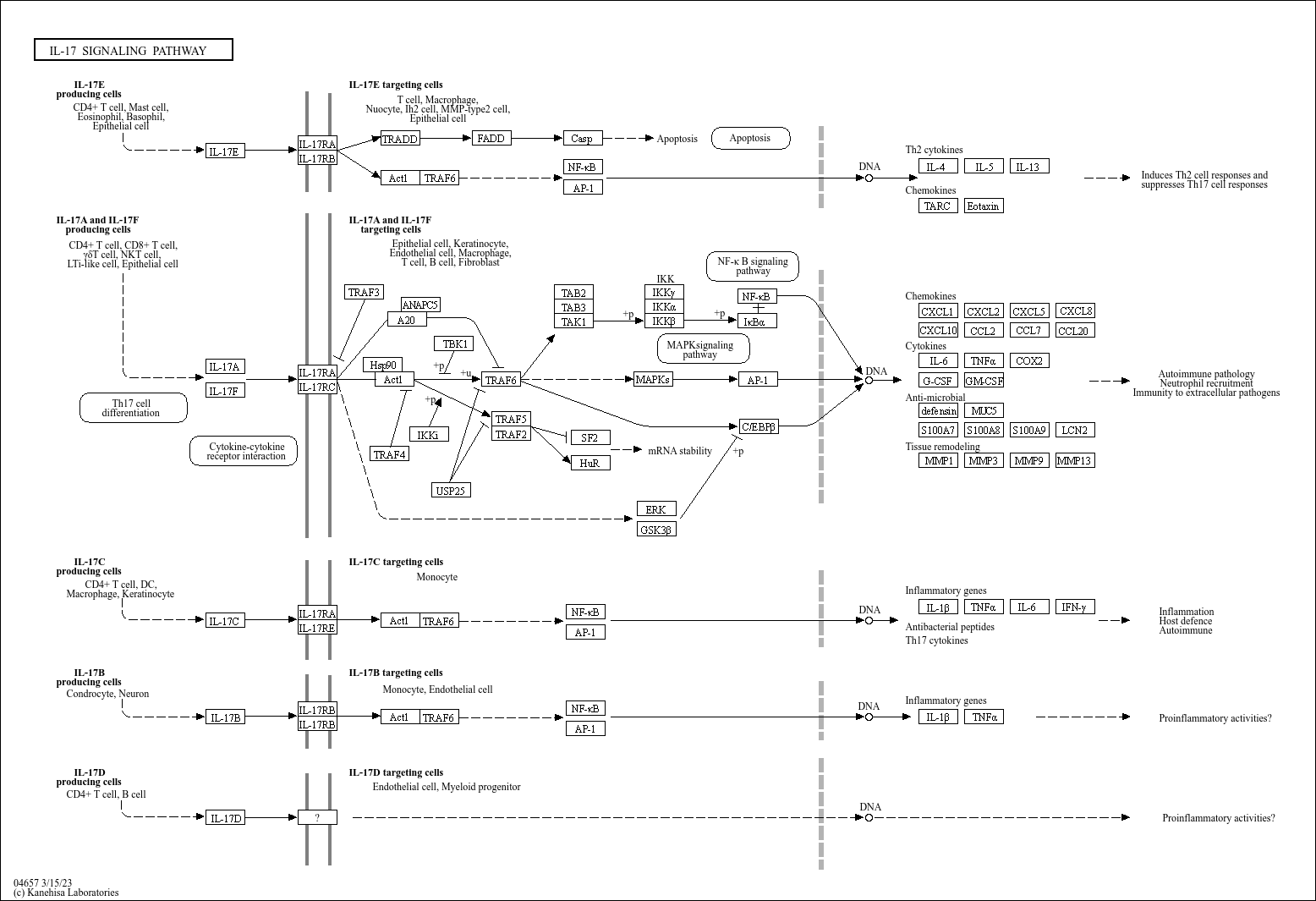
ore of basic research: It focuses on the inflammation activation mechanism after IL-17 family cytokines (mainly IL-17A/F) bind to receptors, which is widely involved in the pathological processes of infectious diseases, autoimmune diseases, and tumors. After IL-17A/F binds to the receptor complex composed of IL-17RA/RC, it recruits TRAF6 via the SEFIR domain in the cytoplasmic segment of the receptor, activating the NF-κB, MAPK (p38/ERK), and STAT3 pathways. This promotes the secretion of inflammatory factors such as IL-6, TNF-α, and CXCL8, as well as matrix metalloproteinases (MMPs), recruiting neutrophils to infiltrate inflammatory sites and enhancing tissue inflammatory responses. Research focuses include the assembly mechanism of the IL-17 receptor complex, response differences of different cell types (epithelial cells, fibroblasts, immune cells) to IL-17, synergistic effects between this pathway and other inflammatory pathways (e.g., TNF-α pathway), and regulatory mechanisms of excessive pathway activation in autoimmune diseases (e.g., rheumatoid arthritis, psoriasis).
Core key proteins: IL-17A/F, IL-17RA/RC (receptor subunits), TRAF6 (signal adaptor), NF-κB (p65/p50), MAPK (p38/ERK/JNK), STAT3, IL-6, TNF-α, CXCL8 (chemokine), MMP3/9 (matrix metalloproteinases), ACT1 (signal adaptor protein).
Core key proteins: IL-17A/F, IL-17RA/RC (receptor subunits), TRAF6 (signal adaptor), NF-κB (p65/p50), MAPK (p38/ERK/JNK), STAT3, IL-6, TNF-α, CXCL8 (chemokine), MMP3/9 (matrix metalloproteinases), ACT1 (signal adaptor protein).
Product list
-
{{item.title}}{{item.react}}{{item.applicat}}
Product list
Product name
Reactivity
Application
Related Resource Links



Related Promotional Journal Downloads


Explore Our Recommended Popular Products
More products

30,000+ high- quality products available online
Primary Antibodies, Secondary Antibodies, mIHC Kits, ELISA Kits, Proteins, Molecular Biology Products,Cell Lines,Reagents ...
Contact Us
-

400-801-6722
-

support@lamarck.cn
-


Order
-

Message