


In the field of immunoassays, the sandwich assay and competitive assay are two core technologies based on antigen-antibody specific reactions, widely applied in research scenarios such as protein quantification and small molecule detection. Leveraging its in-depth understanding of immunoassay principles, Lamarck provides critical support for the efficient implementation of both methods through antibody products and experimental support tailored to technical needs, enabling researchers to obtain accurate detection data.
Competitive Assay: A "Competitive Inhibition" Detection Protocol for Small Molecules
The competitive assay is based on the principle that antigens in the sample compete with labeled antigens for antibody binding. Its core advantages include suitability for small-molecule detection and relatively simple operation, making it ideal for the quantitative analysis of small-molecule substances lacking multiple binding epitopes (e.g., hormones, drugs, toxins).
(I) Core Technical Principles and Key Elements
Principle: Specific antibodies are coated on a solid-phase carrier. A mixture of the test sample (containing unlabeled target antigen) and labeled target antigen is then added. The unlabeled antigen in the sample competes with the labeled antigen for binding to the antibodies on the solid phase. The higher the concentration of unlabeled antigen in the sample, the less labeled antigen binds to the antibodies, resulting in a weaker final signal. Quantification of the target antigen in the sample is achieved by comparing the signal intensity with that of standard solutions.
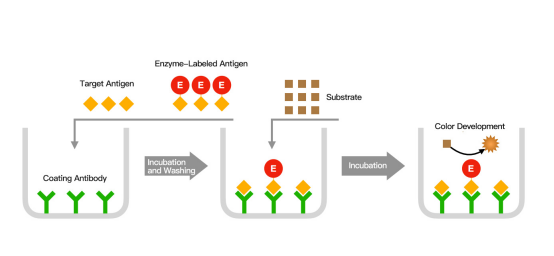
Key Elements:
The antibody must exhibit high-specificity binding to the target antigen (whether labeled or not) to ensure the specificity of the competitive reaction.
The labeled antigen must retain the same antibody-binding activity as the unlabeled antigen, avoiding changes in affinity due to labeling that could affect the competitive equilibrium.
(II) Lamarck’s Adaptive Support
Supply of High-Specificity Antibodies: Lamarck offers high-specificity monoclonal antibodies against small-molecule targets (e.g., cortisol, testosterone, pesticide residues). These antibodies precisely recognize the target molecules and effectively exclude interference from other structurally similar substances in the sample, ensuring the specificity of the competitive reaction.
Labeled Antigen Matching Services: Validated labeled target antigens (e.g., enzyme-labeled, fluorescent-labeled) are available. The labeling process strictly preserves the antigen’s antibody-binding activity, ensuring fair competition with unlabeled antigens in the sample and guaranteeing the reliability of detection results.
Experimental Optimization Recommendations: For key challenges in competitive assays—such as “optimizing antigen-antibody ratio” and “controlling incubation conditions”—Lamarck provides personalized optimization advice, helping researchers address issues such as excessively strong or weak signals and poor linearity of the standard curve.
(III) Core Application Scenarios
Hormone Detection: E.g., quantitative analysis of thyroid hormones (T3, T4) and sex hormones (estrogen, progesterone) in serum.
Small-Molecule Drug Monitoring: E.g., dynamic detection of drug concentrations in blood or tissues during studies of drug metabolism in animals.
Environmental Pollutant Detection: E.g., quantitative screening for mycotoxins (aflatoxin B1) and pesticide residues (organophosphates) in food or water samples.
Related Resource Links



Related Promotional Journal Downloads


Explore Our Recommended Popular Products
More products




30,000+ high- quality products available online
Primary Antibodies, Secondary Antibodies, mIHC Kits, ELISA Kits, Proteins, Molecular Biology Products,Cell Lines,Reagents ...
Contact Us
-

400-801-6722
-

support@lamarck.cn
-


Order
-

Message