


In the field of immunoassays, the sandwich assay and competitive assay are two core technologies based on antigen-antibody specific reactions, widely applied in research scenarios such as protein quantification and small molecule detection. Leveraging its in-depth understanding of immunoassay principles, Lamarck provides critical support for the efficient implementation of both methods through antibody products and experimental support tailored to technical needs, enabling researchers to obtain accurate detection data.
Sandwich Assay: A Highly Sensitive "Dual-Antibody Capture" Quantitative Protocol
The sandwich assay achieves specific capture of target antigens and signal amplification through the synergistic action of "capture antibodies + detection antibodies". Its core advantages lie in high sensitivity and high specificity, making it particularly suitable for the quantitative detection of large-molecular-weight proteins (e.g., cytokines, tumor markers).
(I) Core Technical Principles and Key Elements
Principle: Specific "capture antibodies" are coated on a solid-phase carrier (e.g., microtiter plates). After adding the test sample, the target antigen in the sample binds to the capture antibodies. Subsequently, labeled (enzyme, fluorescence, etc.) "detection antibodies" are added to form a "capture antibody-antigen-detection antibody" sandwich complex. Quantitative analysis of the antigen is achieved by detecting the signal intensity of the label.
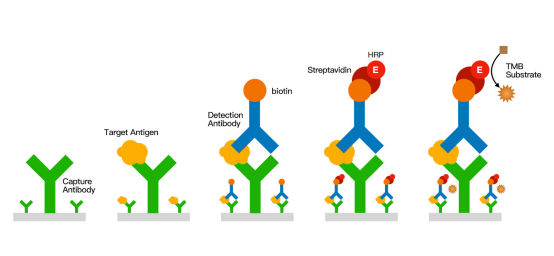
Key Elements:
The two antibodies must recognize distinct and non-overlapping epitopes on the antigen to avoid competing for binding sites and ensure stable complex formation.
Capture antibodies require high affinity to ensure effective capture of low-abundance antigens; detection antibodies must have stable labeling efficiency to guarantee a linear correlation between signal and antigen concentration.
(II) Lamarck’s Adaptive Support
Antibody Pairing Solutions: For common detection targets (e.g., IL-6, TNF-α, AFP), Lamarck offers validated "capture antibody + detection antibody" paired products. The two antibodies recognize non-overlapping epitopes of the antigen, eliminating the need for researchers to perform self-screening and directly reducing experimental trial-and-error costs.
High-Performance Antibody Characteristics: Capture antibodies are high-affinity monoclonal antibodies, ensuring efficient capture of low-concentration antigens in samples; detection antibody labeling (HRP, Biotin, etc.) is optimized for high labeling efficiency and stable signals, safeguarding the accuracy of quantitative results.
Experimental Protocol Support: Targeted operating guidelines are provided, including recommendations for key parameters such as coating concentration, incubation time, and washing conditions, helping researchers quickly establish a stable sandwich assay detection system.
(III) Core Application Scenarios
Cytokine Quantification: E.g., detecting the expression levels of cytokines such as IL-1β and IL-10 in inflammatory responses.
Tumor Marker Detection: E.g., quantitative analysis of AFP (alpha-fetoprotein) and CEA (carcinoembryonic antigen) in serum, supporting tumor-related research.
Protein Expression Validation: E.g., detecting the expression level of recombinant proteins in cell culture supernatants for optimization of protein preparation processes.
Related Resource Links



Related Promotional Journal Downloads


Explore Our Recommended Popular Products
More products

30,000+ high- quality products available online
Primary Antibodies, Secondary Antibodies, mIHC Kits, ELISA Kits, Proteins, Molecular Biology Products,Cell Lines,Reagents ...
Contact Us
-

400-801-6722
-

support@lamarck.cn
-


Order
-

Message