


Synaptic vesicle cycle
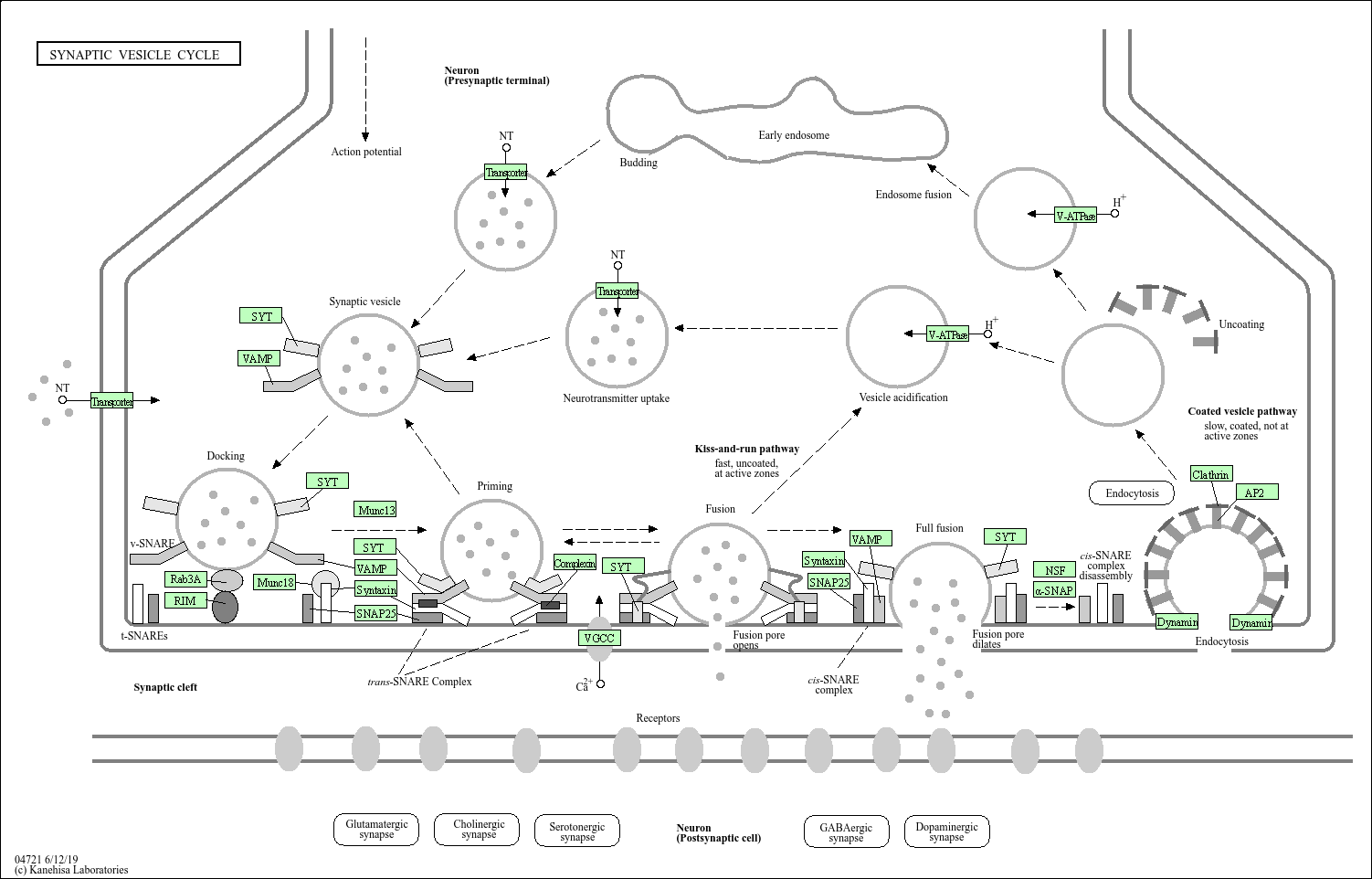
Core of basic research: Deciphers the complete cycle mechanism of synaptic vesicles ("filling-anchoring-exocytosis-retrieval-recycling") at nerve terminals, critical for sustaining synaptic transmission. The cycle consists of five steps: ① Synaptic vesicles are filled with neurotransmitters via membrane transporters (e.g., VAChT, DAT); ② Filled vesicles bind to presynaptic membrane anchoring proteins via Rab GTPases to complete anchoring; ③ Upon neuronal excitation, calcium influx triggers vesicle fusion with the presynaptic membrane via the SNARE complex (Syntaxin, VAMP, SNAP-25) to release neurotransmitters (exocytosis); ④ Vesicle membranes are retrieved via clathrin-mediated endocytosis; ⑤ Retrieved vesicles are acidified (by V-ATPase) and refilled with neurotransmitters to enter the next cycle. Research focuses on the membrane fusion mechanism mediated by the SNARE complex, regulation of clathrin-mediated endocytosis, the triggering role of calcium in the cycle, the sorting function of Rab GTPases, and pathway abnormalities in neuromuscular diseases (e.g., myasthenia gravis, hereditary neuropathy).
Core key proteins: Synaptic vesicle, SNARE complex (Syntaxin 1A, VAMP2, SNAP-25), Synaptotagmin (calcium sensor mediating exocytosis triggering), Clathrin (endocytosis-related protein), Dynamin (GTPase mediating endocytic vesicle scission), V-ATPase (synaptic vesicle acidification enzyme), neurotransmitter transporters (VAChT, DAT, VMAT for filling), Rab GTPases (Rab3/Rab5 for vesicle transport and sorting), Munc18 (membrane fusion regulatory protein), α-Synuclein (synaptic vesicle function regulatory protein).
Core key proteins: Synaptic vesicle, SNARE complex (Syntaxin 1A, VAMP2, SNAP-25), Synaptotagmin (calcium sensor mediating exocytosis triggering), Clathrin (endocytosis-related protein), Dynamin (GTPase mediating endocytic vesicle scission), V-ATPase (synaptic vesicle acidification enzyme), neurotransmitter transporters (VAChT, DAT, VMAT for filling), Rab GTPases (Rab3/Rab5 for vesicle transport and sorting), Munc18 (membrane fusion regulatory protein), α-Synuclein (synaptic vesicle function regulatory protein).
Product list
-
{{item.title}}{{item.react}}{{item.applicat}}
Product list
Product name
Reactivity
Application
Related Resource Links



Related Promotional Journal Downloads


Explore Our Recommended Popular Products
More products

30,000+ high- quality products available online
Primary Antibodies, Secondary Antibodies, mIHC Kits, ELISA Kits, Proteins, Molecular Biology Products,Cell Lines,Reagents ...
Contact Us
-

400-801-6722
-

support@lamarck.cn
-


Order
-

Message