


NOD-like receptor signaling pathway
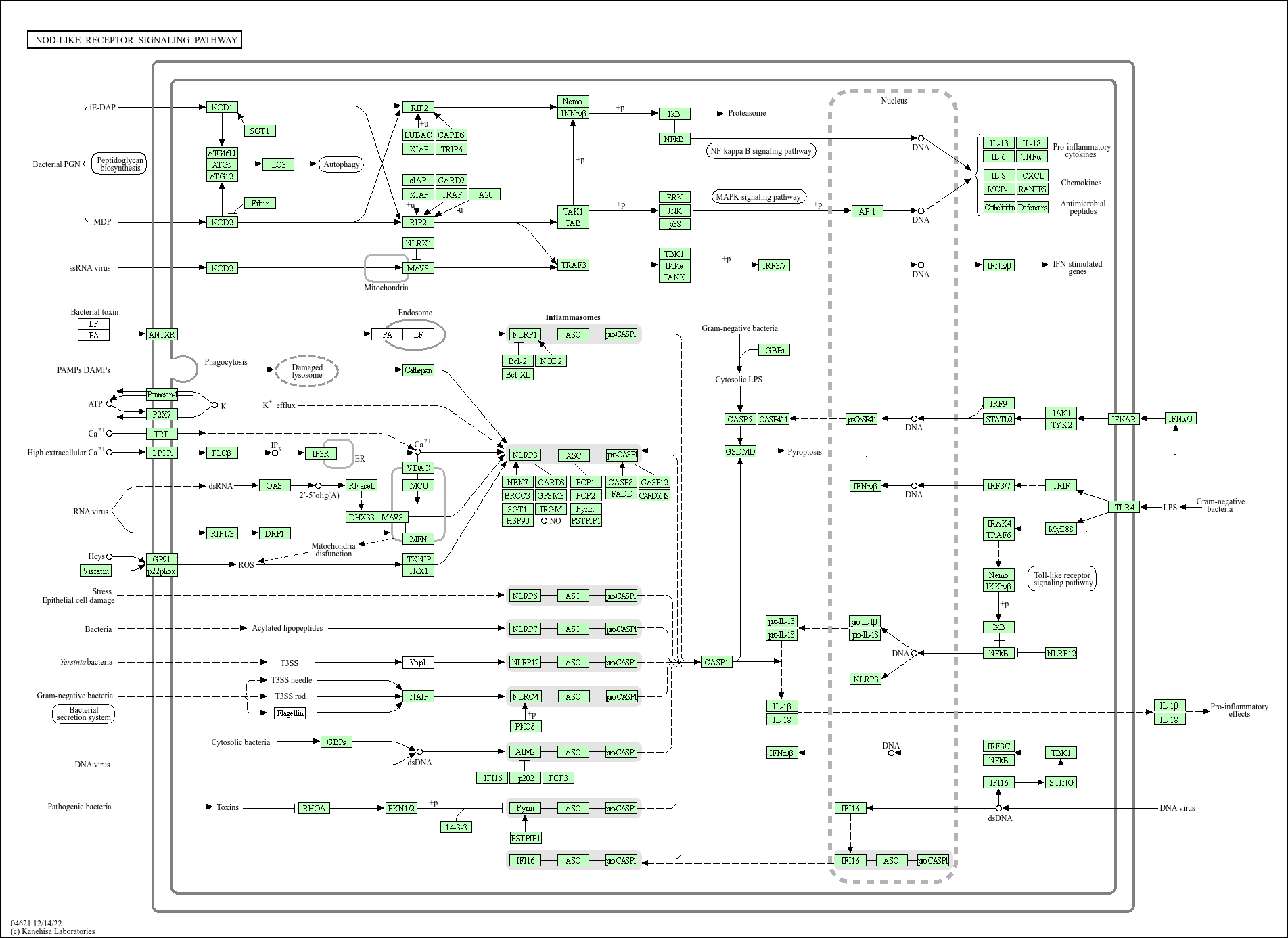
Core of basic research: Deciphers the mechanism by which cytosolic pattern recognition receptors (NLR family) recognize bacterial peptidoglycans to activate inflammation or pyroptosis, a key innate immune response to intracellular bacterial infections. NOD1 recognizes diaminopimelic acid (DAP) from Gram-negative bacteria, while NOD2 recognizes muramyl dipeptide (MDP) from Gram-positive bacteria. Both recruit RIPK2 kinase upon activation, activating the NF-κB pathway to secrete inflammatory factors such as IL-6 and TNF-α. Additionally, NLR family members (e.g., NLRP3, NLRC4) assemble with ASC and caspase-1 to form inflammasomes. Activated caspase-1 cleaves pro-IL-1β and pro-IL-18 into mature forms, while mediating pyroptosis. Research focuses on ligand recognition specificity of NLRs, regulatory mechanisms of inflammasome assembly, differences and connections between pyroptosis and apoptosis, and pathway abnormalities caused by NOD2 mutations in autoimmune diseases (e.g., Crohn’s disease).
Core key proteins: NOD1/NOD2, RIPK2 (serine/threonine kinase), NF-κB (p65/p50), ASC (inflammasome adaptor), caspase-1, IL-1β/IL-18 (inflammatory factors), NLRP3/NLRC4 (core inflammasome components), Gasdermin D (pyroptosis executor), TRAF6 (signal adaptor).
Core key proteins: NOD1/NOD2, RIPK2 (serine/threonine kinase), NF-κB (p65/p50), ASC (inflammasome adaptor), caspase-1, IL-1β/IL-18 (inflammatory factors), NLRP3/NLRC4 (core inflammasome components), Gasdermin D (pyroptosis executor), TRAF6 (signal adaptor).
Product list
-
{{item.title}}{{item.react}}{{item.applicat}}
Product list
Product name
Reactivity
Application
Related Resource Links


Related Promotional Journal Downloads


Explore Our Recommended Popular Products
More products

30,000+ high- quality products available online
Primary Antibodies, Secondary Antibodies, mIHC Kits, ELISA Kits, Proteins, Molecular Biology Products,Cell Lines,Reagents ...
Contact Us
-

400-801-6722
-

support@lamarck.cn
-


Order
-

Message