


Hedgehog signaling pathway
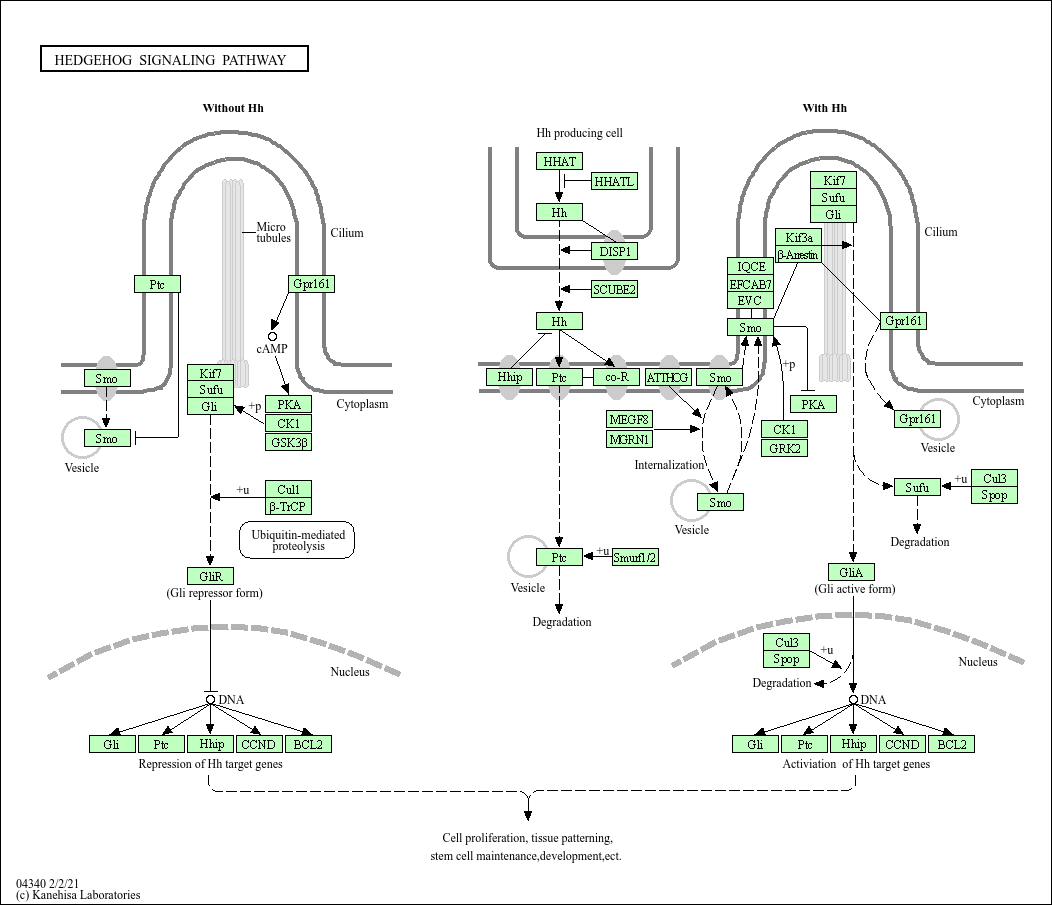
An evolutionarily highly conserved developmental regulatory pathway, its core molecules include Hh ligands (Sonic Hh, Indian Hh, Desert Hh), receptor Ptch1, co-receptor Smo, and Gli family transcription factors (Gli1-3). In the resting state, Ptch1 inhibits Smo activity; binding of Hh ligands to Ptch1 relieves this inhibition, allowing Smo to enter cilia and activate Gli transcription factors to regulate target gene expression. Its core functions include organ morphogenesis during embryonic development (e.g., limb development, neural tube formation), maintenance of adult stem cell self-renewal, and tissue regeneration (e.g., liver repair). Abnormal activation of the pathway is associated with the occurrence of various tumors, such as basal cell carcinoma (almost all have pathway mutations), medulloblastoma, and pancreatic cancer. Inhibitors targeting Smo have been used in clinical treatment.
Core function: A conserved developmental regulatory pathway that regulates embryonic development, stem cell self-renewal, and tissue regeneration; abnormal activation is associated with tumorigenesis. Key regulatory molecules: Hh ligands (Sonic/Indian/Desert Hh), Ptch1, Smo, Gli1/2/3.
Core function: A conserved developmental regulatory pathway that regulates embryonic development, stem cell self-renewal, and tissue regeneration; abnormal activation is associated with tumorigenesis. Key regulatory molecules: Hh ligands (Sonic/Indian/Desert Hh), Ptch1, Smo, Gli1/2/3.
Product list
-
{{item.title}}{{item.react}}{{item.applicat}}
Product list
Product name
Reactivity
Application
Related Resource Links


Related Promotional Journal Downloads


Explore Our Recommended Popular Products
More products

30,000+ high- quality products available online
Primary Antibodies, Secondary Antibodies, mIHC Kits, ELISA Kits, Proteins, Molecular Biology Products,Cell Lines,Reagents ...
Contact Us
-

400-801-6722
-

support@lamarck.cn
-


Order
-

Message