


Rap1 signaling pathway
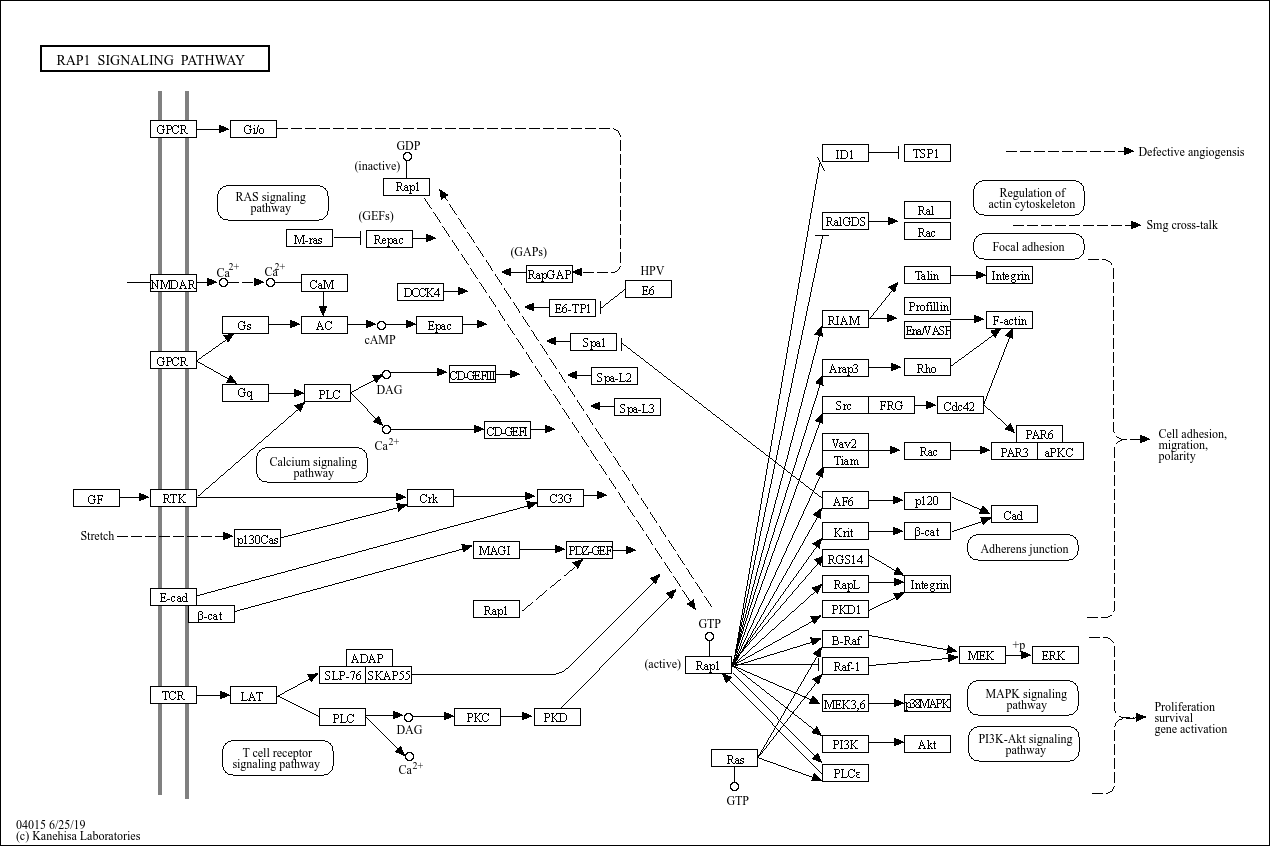
As a small GTPase of the Ras superfamily, Rap1 is an important molecule connecting cell surface receptors to downstream signal pathways, divided into two isoforms: Rap1A and Rap1B. Its activation depends on GTP binding mediated by GEF (e.g., C3G, Epac), and inactivation is regulated by GAP. Core functions include: regulating cell proliferation and survival by activating MAPK and PI3K-Akt pathways; enhancing cell-cell and cell-matrix adhesion through interactions with Cadherin and Integrin to maintain tissue integrity; participating in immune cell homing and vascular endothelial cell function regulation. Pathway abnormalities are associated with various diseases; for example, excessive activation of Rap1 promotes tumor cell migration and invasion, related to the metastasis of breast cancer and colorectal cancer; functional deficiency may lead to immunodeficiency diseases and cardiovascular diseases.
Core function: Regulate cell proliferation, adhesion, and differentiation by activating downstream pathways, maintaining tissue integrity and immune cell function. Key regulatory molecules: Rap1A/B, Raf, MEK, ERK, PI3K, Cadherin, Integrin.
Core function: Regulate cell proliferation, adhesion, and differentiation by activating downstream pathways, maintaining tissue integrity and immune cell function. Key regulatory molecules: Rap1A/B, Raf, MEK, ERK, PI3K, Cadherin, Integrin.
Product list
-
{{item.title}}{{item.react}}{{item.applicat}}
Product list
Product name
Reactivity
Application
Related Resource Links


Related Promotional Journal Downloads


Explore Our Recommended Popular Products
More products

30,000+ high- quality products available online
Primary Antibodies, Secondary Antibodies, mIHC Kits, ELISA Kits, Proteins, Molecular Biology Products,Cell Lines,Reagents ...
Contact Us
-

400-801-6722
-

support@lamarck.cn
-


Order
-

Message