


Adherens junction
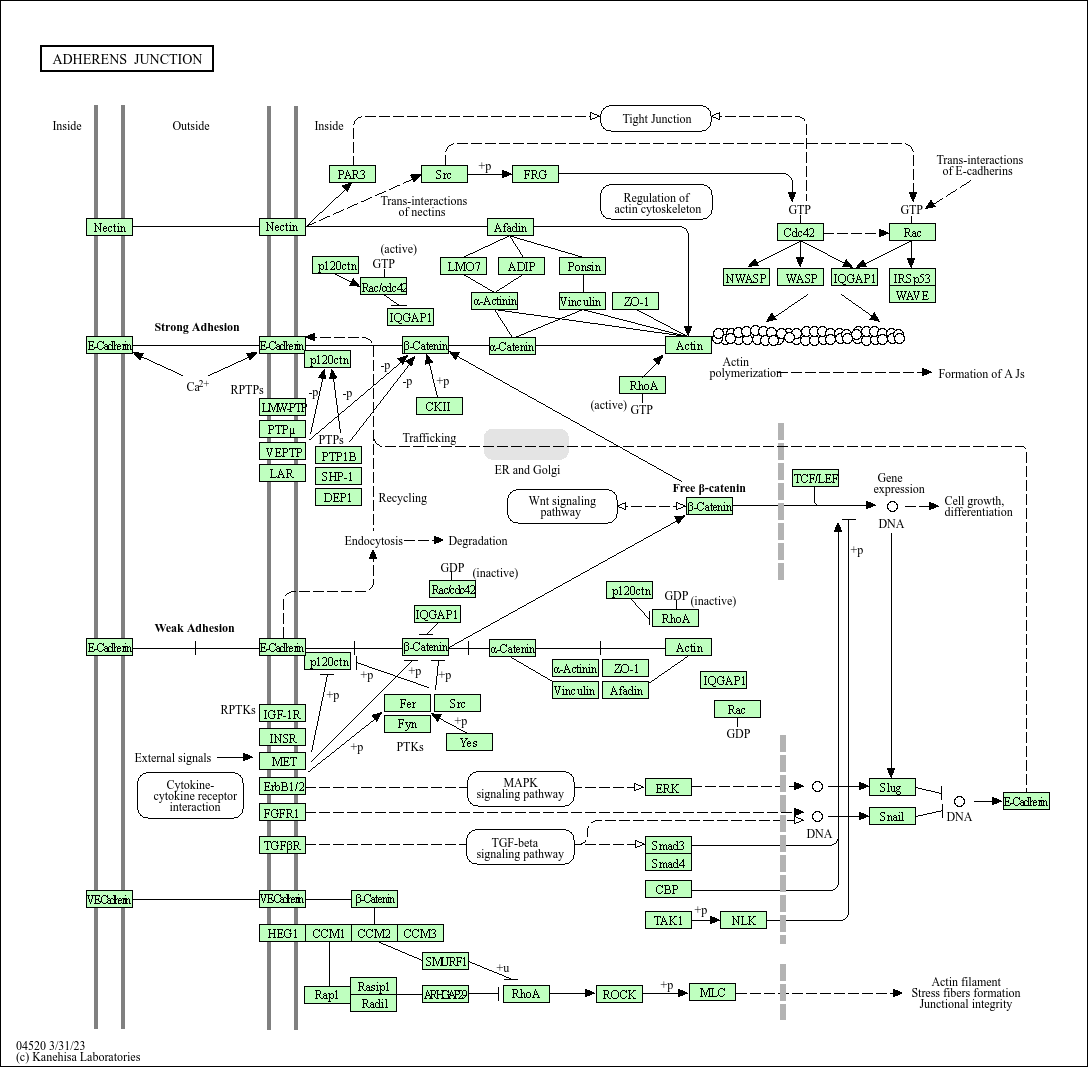
Core of basic research: Focuses on the molecular mechanism by which adherens junctions mediate stable intercellular adhesion and transmit mechanical signals, critical for maintaining tissue integrity and morphogenesis. The core structure is the Cadherin-Catenin complex: Classical cadherins (E-, N-, P-Cadherin) bind adjacent cells via calcium-dependent homophilic interactions in their extracellular domains; their intracellular domains associate with β-Catenin and α-Catenin, further linking to the actin cytoskeleton to form continuous intercellular adhesion belts. This pathway not only maintains cell arrangement but also participates in Wnt signaling via β-Catenin, regulating cell proliferation and differentiation. Research focuses include the expression specificity of cadherins, phosphorylation regulation of catenins, dynamic associations between adherens junctions and the cytoskeleton, and the association of pathway abnormalities with tumor invasion (e.g., downregulated E-Cadherin causing cell detachment) and developmental malformations.
Core key proteins: E-Cadherin, N-Cadherin, P-Cadherin, β-Catenin, α-Catenin, γ-Catenin, p120-Catenin, Actin, actin-binding proteins (α-Actinin, Vinculin), Wnt signaling-related proteins (regulating β-Catenin stability).
Core key proteins: E-Cadherin, N-Cadherin, P-Cadherin, β-Catenin, α-Catenin, γ-Catenin, p120-Catenin, Actin, actin-binding proteins (α-Actinin, Vinculin), Wnt signaling-related proteins (regulating β-Catenin stability).
Product list
-
{{item.title}}{{item.react}}{{item.applicat}}
Product list
Product name
Reactivity
Application
Related Resource Links

Related Promotional Journal Downloads


Explore Our Recommended Popular Products
More products

30,000+ high- quality products available online
Primary Antibodies, Secondary Antibodies, mIHC Kits, ELISA Kits, Proteins, Molecular Biology Products,Cell Lines,Reagents ...
Contact Us
-

400-801-6722
-

support@lamarck.cn
-


Order
-

Message