


Necroptosis
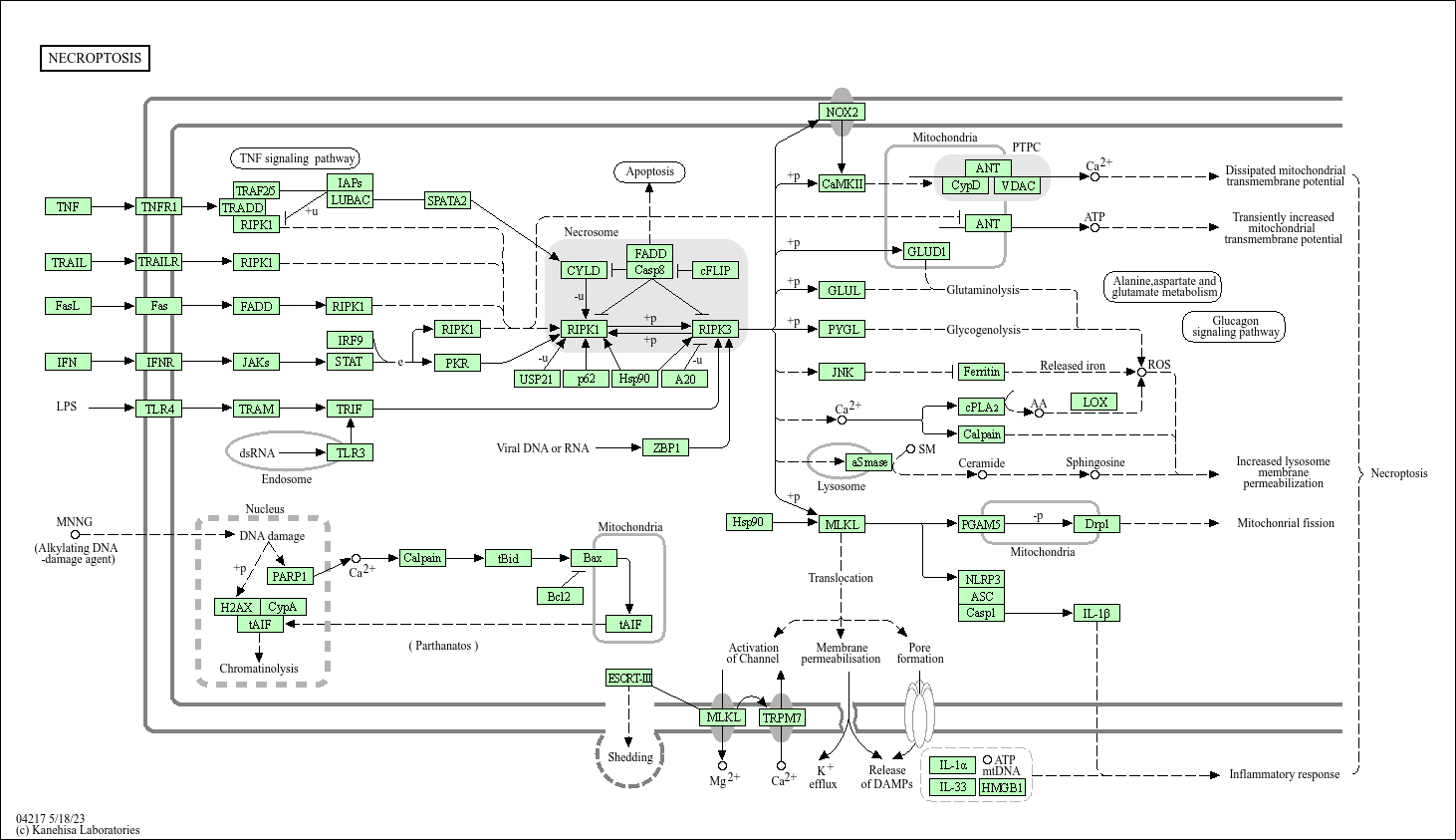
Core of basic research: Clarifies the molecular mechanism of programmed necrosis mediated by Receptor-Interacting Protein Kinases (RIPKs), an alternative death pathway activated when apoptosis is suppressed. The core pathway is the RIPK1-RIPK3-MLKL cascade: After activation of death receptors (TNFR1, Fas), if caspase-8 activity is inhibited, RIPK1 and RIPK3 form necrosomes; RIPK3 phosphorylates Mixed Lineage Kinase Domain-Like Protein (MLKL), which oligomerizes and inserts into the cell membrane, disrupting membrane integrity and causing cell necrosis. This pathway participates in inflammatory responses, infection defense, and ischemia-reperfusion injury. Research focuses include the activation regulation of RIPK1/RIPK3, the antagonistic role of caspase-8 in the necrotic pathway, the membrane localization mechanism of MLKL, the association between necroptosis and inflammatory factors (TNF-α, IL-6), and the association of pathway abnormalities with inflammatory diseases and tumors.
Core key proteins: Receptor-Interacting Protein Kinase 1 (RIPK1), Receptor-Interacting Protein Kinase 3 (RIPK3), Mixed Lineage Kinase Domain-Like Protein (MLKL), Death Receptors (TNFR1, Fas), TRIF (TLR signal adapter, capable of activating RIPK3), caspase-8 (inhibiting the necrotic pathway), FADD (Fas-Associated Death Domain protein), TNF-α/TNFR1 signal complex, MLKL oligomers (membrane-disrupting proteins).
Core key proteins: Receptor-Interacting Protein Kinase 1 (RIPK1), Receptor-Interacting Protein Kinase 3 (RIPK3), Mixed Lineage Kinase Domain-Like Protein (MLKL), Death Receptors (TNFR1, Fas), TRIF (TLR signal adapter, capable of activating RIPK3), caspase-8 (inhibiting the necrotic pathway), FADD (Fas-Associated Death Domain protein), TNF-α/TNFR1 signal complex, MLKL oligomers (membrane-disrupting proteins).
Product list
-
{{item.title}}{{item.react}}{{item.applicat}}
Product list
Product name
Reactivity
Application
Related Resource Links



Related Promotional Journal Downloads


Explore Our Recommended Popular Products
More products

30,000+ high- quality products available online
Primary Antibodies, Secondary Antibodies, mIHC Kits, ELISA Kits, Proteins, Molecular Biology Products,Cell Lines,Reagents ...
Contact Us
-

400-801-6722
-

support@lamarck.cn
-


Order
-

Message