


Cell cycle
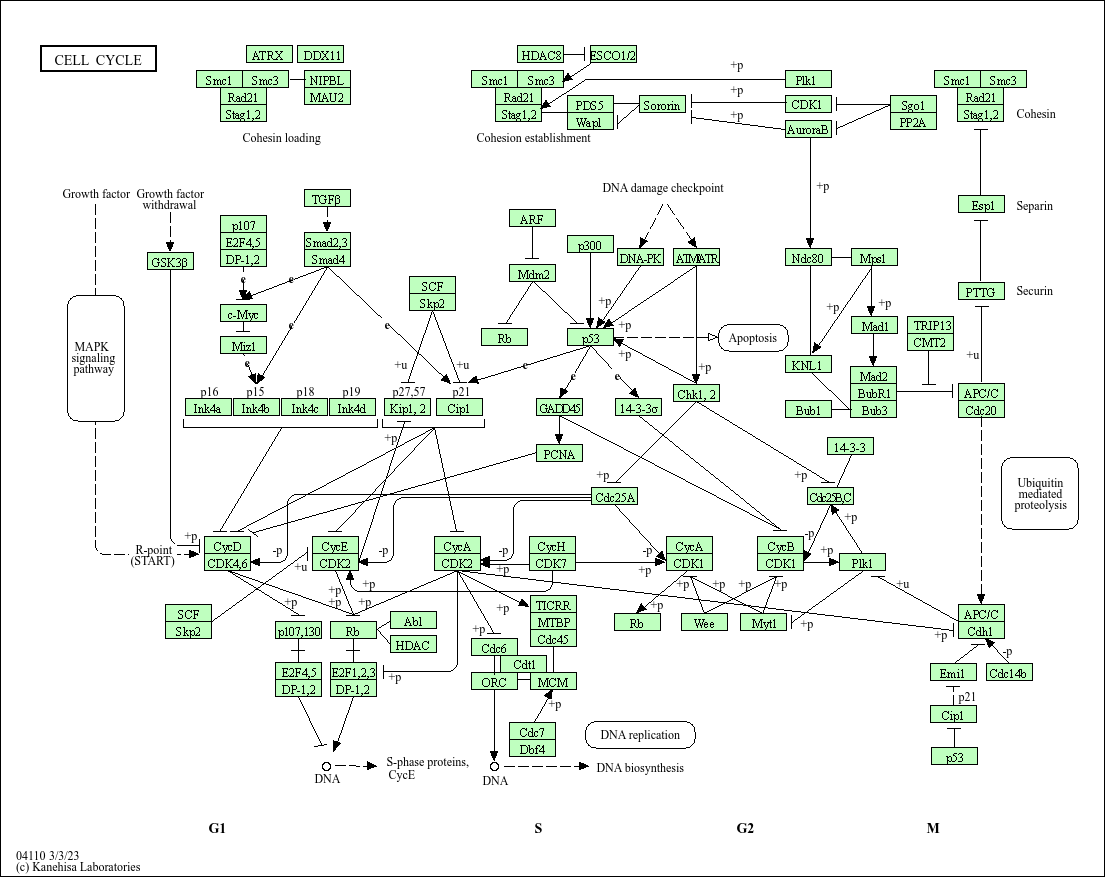
Core of basic research: Clarifies the periodic regulatory mechanism of cells from interphase (G1→S→G2 phases) to mitosis (M phase), critical for maintaining cell proliferation and genetic stability. The core regulatory network is the Cyclin-CDK (Cyclin-Dependent Kinase) complex: G1 phase Cyclin D-CDK4/6 complex phosphorylates the Retinoblastoma protein (Rb), releasing E2F transcription factors to initiate S phase-related gene expression; S phase Cyclin E-CDK2 complex promotes DNA replication initiation; G2 phase Cyclin A-CDK2/CDK1 complex regulates DNA replication completion and M phase initiation; M phase Cyclin B-CDK1 complex drives cells into mitosis (nuclear envelope breakdown, chromosome segregation). Meanwhile, cell cycle checkpoints (G1/S checkpoint, G2/M checkpoint, spindle assembly checkpoint) monitor DNA integrity and chromosome segregation via proteins such as p53 and Chk1/Chk2 to prevent abnormal cell proliferation. Research focuses include the activation and degradation regulation of Cyclin-CDK complexes, signal transduction mechanisms of checkpoints, ubiquitin-mediated Cyclin degradation (APC/C complex), and the association of pathway abnormalities with tumors (Cyclin overexpression or CDK inhibitor mutations) and developmental abnormalities.
Core key proteins: Cyclins (Cyclin A/B/D/E), Cyclin-Dependent Kinases (CDK1/2/4/6), CDK inhibitors (p21/Cip1, p27/Kip1, p16/INK4a), Retinoblastoma protein (Rb), E2F transcription factor family, p53 (core G1/S checkpoint protein), Chk1/Chk2 (DNA damage response kinases), APC/C complex (Anaphase-Promoting Complex, degrading Cyclins), cohesin complex (maintaining sister chromatid cohesion), spindle assembly checkpoint proteins (Mad2, BubR1).
Core key proteins: Cyclins (Cyclin A/B/D/E), Cyclin-Dependent Kinases (CDK1/2/4/6), CDK inhibitors (p21/Cip1, p27/Kip1, p16/INK4a), Retinoblastoma protein (Rb), E2F transcription factor family, p53 (core G1/S checkpoint protein), Chk1/Chk2 (DNA damage response kinases), APC/C complex (Anaphase-Promoting Complex, degrading Cyclins), cohesin complex (maintaining sister chromatid cohesion), spindle assembly checkpoint proteins (Mad2, BubR1).
Product list
-
{{item.title}}{{item.react}}{{item.applicat}}
Product list
Product name
Reactivity
Application
Related Resource Links



Related Promotional Journal Downloads


Explore Our Recommended Popular Products
More products

30,000+ high- quality products available online
Primary Antibodies, Secondary Antibodies, mIHC Kits, ELISA Kits, Proteins, Molecular Biology Products,Cell Lines,Reagents ...
Contact Us
-

400-801-6722
-

support@lamarck.cn
-


Order
-

Message