


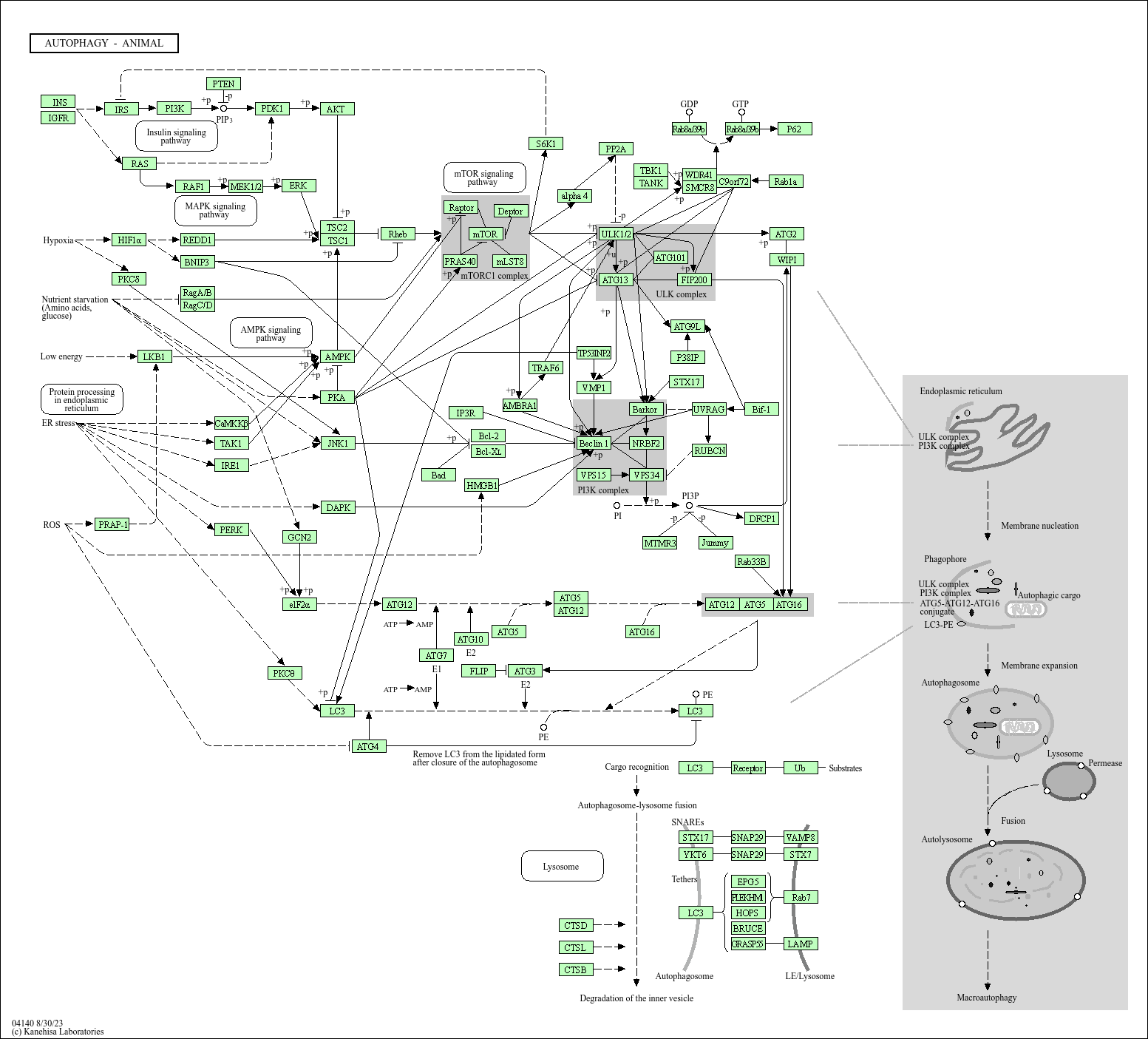
Autophagy - animal
Core of basic research: Deciphers the molecular mechanism by which animal cells degrade intracellular abnormal proteins and damaged organelles via autophagy for nutrient recycling, critical for maintaining cellular homeostasis and responding to stress. The core process involves three steps: Initiation (ULK1 complex activation to trigger autophagosome formation), nucleation (Beclin-1-VPS34 complex promoting phagophore membrane formation), and elongation/maturation (lipidated LC3 participating in autophagosome membrane elongation; autophagosome fusing with lysosome to form autolysosome for content degradation). Autophagy is negatively regulated by the mTOR pathway (mTOR inhibits the ULK1 complex under nutrient sufficiency) and activated by AMPK under energy deprivation. Research focuses include the autophagic signal regulatory network, the membrane source of autophagosome formation, the mechanism of autophagosome-lysosome fusion, cross-talk between autophagy and apoptosis, and the association of pathway abnormalities with tumors and neurodegenerative diseases (e.g., Alzheimer’s disease with abnormal protein accumulation).
Core key proteins: ULK1 complex (ULK1, Atg13, FIP200), Beclin-1-VPS34 complex (Beclin-1, VPS34, VPS15), Atg family proteins (Atg5, Atg7, Atg12, Atg16L1), Microtubule-Associated Protein Light Chain 3 (LC3-I/II), p62/SQSTM1 (autophagic substrate receptor), lysosomal enzymes (Cathepsin B/D/L), mTOR (negative regulator), AMPK (positive regulator), autolysosome (degradation site).
Core key proteins: ULK1 complex (ULK1, Atg13, FIP200), Beclin-1-VPS34 complex (Beclin-1, VPS34, VPS15), Atg family proteins (Atg5, Atg7, Atg12, Atg16L1), Microtubule-Associated Protein Light Chain 3 (LC3-I/II), p62/SQSTM1 (autophagic substrate receptor), lysosomal enzymes (Cathepsin B/D/L), mTOR (negative regulator), AMPK (positive regulator), autolysosome (degradation site).
Product list
-
{{item.title}}{{item.react}}{{item.applicat}}
Product list
Product name
Reactivity
Application
Related Resource Links


Related Promotional Journal Downloads


Explore Our Recommended Popular Products
More products

30,000+ high- quality products available online
Primary Antibodies, Secondary Antibodies, mIHC Kits, ELISA Kits, Proteins, Molecular Biology Products,Cell Lines,Reagents ...
Contact Us
-

400-801-6722
-

support@lamarck.cn
-


Order
-

Message